HTTP security headers are settings sent by the server along with the page response that tell the browser how to handle your website securely.
In an online store (e.g. PrestaShop), they help reduce real risks such as clickjacking, unwanted resource loading, data leaks in the Referer header, or incorrect interpretation of file types.
The most important headers worth knowing
X-Frame-Options and the frame-ancestors directive in Content-Security-Policy (CSP) protect against embedding the store page in an iframe on external websites, which is a common clickjacking mechanism.
Content-Security-Policy (CSP) makes it possible to define which sources scripts, styles, images, and network connections may load from, thereby reducing the impact of many types of browser-side attacks.
Strict-Transport-Security (HSTS) enforces the use of HTTPS for a given domain (the header works only on HTTPS responses), making it harder to “downgrade” traffic to the unencrypted version of the site.
X-Content-Type-Options: nosniff limits MIME sniffing, that is, the browser “guessing” file types, which is sometimes exploited in certain XSS scenarios.
Referrer-Policy controls how much information about the page address is passed on in the Referer header, which helps limit accidental disclosure of URL parameters.
Permissions-Policy makes it possible to disable unnecessary browser features (e.g. geolocation, microphone, camera), reducing the attack surface in a typical store.
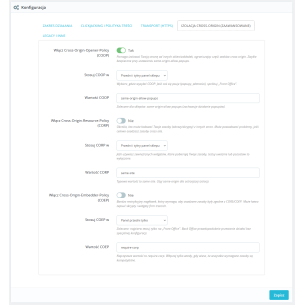
Advanced headers such as Cross-Origin-Opener-Policy (COOP), Cross-Origin-Resource-Policy (CORP), and Cross-Origin-Embedder-Policy (COEP) concern cross-origin isolation and control of resource loading between domains, but they require careful implementation because they may affect external integrations.
Additionally, you will come across “legacy” headers such as X-DNS-Prefetch-Control, X-Permitted-Cross-Domain-Policies, X-Download-Options, or X-XSS-Protection, which depending on the browser have limited significance today, but are still sometimes used as part of configuration hardening.
How to implement security headers in PrestaShop without risking integrations
The key is to implement changes gradually: some headers are practically “safe by definition”, but CSP and COEP can block payments, analytics, or widgets if they are set too restrictively.
That is exactly why we have prepared the Security Headers Pro module, which allows you to enable and configure each header separately, as well as set the scope of operation for the Front Office and Back Office.
The module supports multistore, so you can have different settings for different stores and domains, which in practice is a common need in PrestaShop.
If you want to raise your store’s security level in a controlled and predictable way, HTTP headers are one of the most practical steps worth implementing and testing regularly.


Comments (0)